Micromagnetic studies of three-dimensional pyramidal shell structures
A Knittel and M Franchin and T Fischbacher and F Nasirpouri and S J Bending and H Fangohr, Micromagnetic studies of three-dimensional pyramidal shell structures,
New Journal of Physics 12, 113048 (23 pages) (2010)
Online: journal pdf (free), local postprint pdf
Motivation
Most micromagnetic modelling is focussed on flat (essentially 2d) geometries.
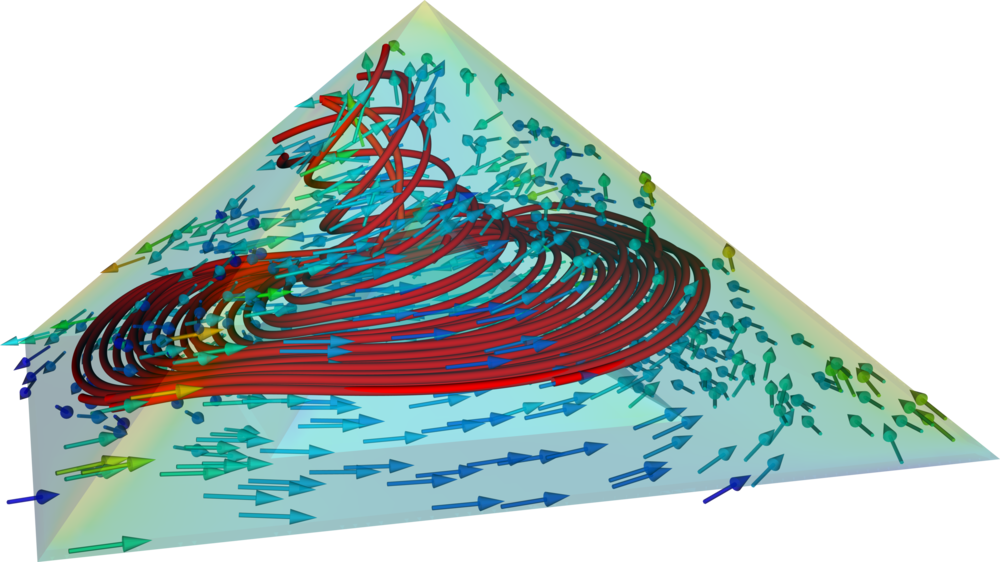
Recent interest through new growth techniques in truely 3d structures, in particular faceted core-shell structures with a non-magnetic core and a soft ferro-magnetic shell.
Summary
systematic numerical analysis of the magnetic properties of pyramidal-shaped core-shell structures in a size range below 400nm.
use standard micromagnetic model without the magnetocrystalline anisotropy term (Nmag software)
vary the thickness of the shell between the limiting cases of an ultra-thin shell and a conventional pyramid and delineate different stable magnetic configurations.
find different kinds of single-domain states (onion, flower, C and S states), and two types of vortex states in larger systems (symmetric and asymmetric vortex states)
derive a phase diagram that specifies the magnetic ground state as a function of size and shell thickness.
investigate metastability by investigating the stability of all occurring configurations for different shell thicknesses.
compute hysteresis for selected sytems
observe that the magnetic behaviour changes distinctively in the limit of ultra-thin shells
Related presentations
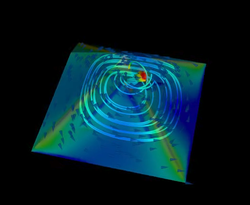
An animation (avi) showing a system with a vortex core pointing to the side of pyramid shell:
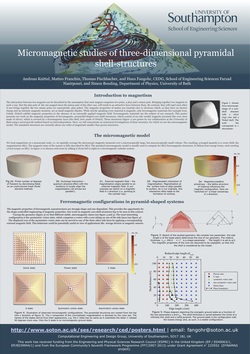
Poster (pdf), targetting non-expert audience with science/engineering background.
Other information
A simulation result from this work has been used as the Conference logo for the Condensed Matter and Materials Physics (CMMP) Conference 2010 in Warwick, UK.