
Additional funding for Group Design Projects
SES Alumni have generously donated funds that can be bid for in a competitive process to enhance Group Design Projects.
The elevator pitch process
Applications
Send applications to Hans Fangohr (fangohr@soton.ac.uk) by Friday 16 October 2009 12:00.
The subject line of the email should read: Application for GDP elevator pitch process
The following information should be included in the body of the email:
GDP project title
team member names
supervisor names
How to prepare
Read the document outlining the process and assessment criteria (pdf/word).
Read the Summary of the investors’ comments on pitches delivered: it is likely that you will benefit from this feedback.
If you can, watch the BBC series Dragons’ den. The format is somewhat similar to the EDP elevator pitch process, and you can learn how to do well by studying the good and bad performances shown.
Summary of the investors’ comments on pitches delivered
We provide some general feedback for the Elevator Pitch Presentations 2007/2008 - 2009/2010. This is the same feedback given to all groups, so not all points may apply to your presentation. We hope you find this feedback useful for similar presentations in the future.
We have found that all groups were enthusiastic about their projects, have taken the process seriously, and done background work to be prepared.
We summarise a few key points to make a successful presentation in this context:
Say at the beginning of the pitch, how much money you request.
Give clear statement what the project is about “Our project is … we see potential applications …” It is easy to forget that others (the investors) know nothing about your project and will be grateful for any high-level one-line description that makes the project more accessible to them.
Provide a clear view on how the school would benefit from your pitch being funded. This could include use for teaching or publicity purposes, for example.
Say what is new about the project, what is the most innovative thing?
If you are allowed to provide paper work (as you are for this pitch), then it is often a good idea to do this. Use this opportunity to help investors to understand and remember your project. Pictures of designs or prototypes or related devices are very useful, and so are any 3d models that you can bring along. Bring a work plan and a budget to demonstrate that you have seriously thought about the project and the extra funding your request.
Bear in mind that the investors may be seeing 15 presentations in a row. After the last presentation they discuss all applications and presentations and decide what to fund. It is at this stage that the paperwork (or models) provided by the groups have real impact: they help to remind the investors of the project and the presentation.
If you know how many investors are part of the process, make sure that you have at least as many copies of your materials, so that each of them can have one.
In addition to your talk, you have a limited amount of time to reply to questions. It is crucial that you use this time effectively. In particular, this means to
answer questions to the point, and stop talking when you have answered the question.
If you don’t know the answer, do not talk about something else: you would be wasting your time (as the investors will only listen for a fixed amount of time).
If you are not sure what the question is, ask for clarification. Do not simply re-iterate your pitch (this is not providing any new information to the investors and thus wasting time).
In summary, it is best to answer as many questions as possible, thus you should try to keep the answers short.
We would like to remind you that it is the task of the investors to assess your pitch and to probe your understanding and presentation of it. It is therefore natural that (following your pitch) you will get questions to which you don’t know the answer, or you may find that the investor question your budget or work plan: remember it is their job to do this. If you leave the presentation with the feeling that your project and pitch have been perfect, then the investors have not done their job properly.
Pictures from the delivery of the pitches 2007/2008
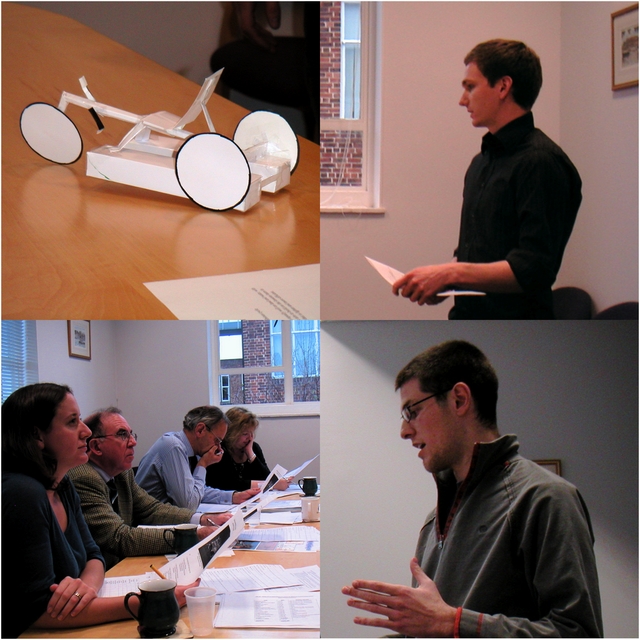
Top left: a paper model of the amphibian bicyle. Bottom left: four of the investors. Top and bottem right: students delivering their pitch to the panel.
Pictures from the delivery of the pitches 2008/2009
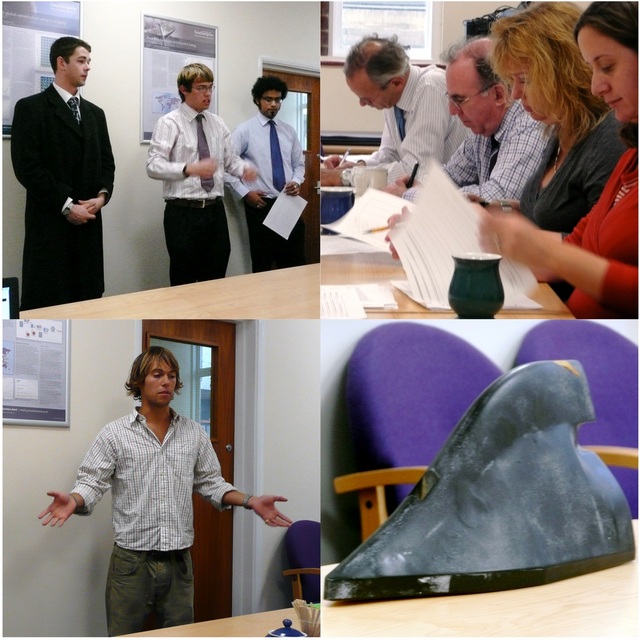
Top right: investors ranking the presentations, Bottom right: a carbon fibre exhibit. Top and Bottom left: students presenting their proposals.
Pictures from the delivery of the pitches 2009/2010
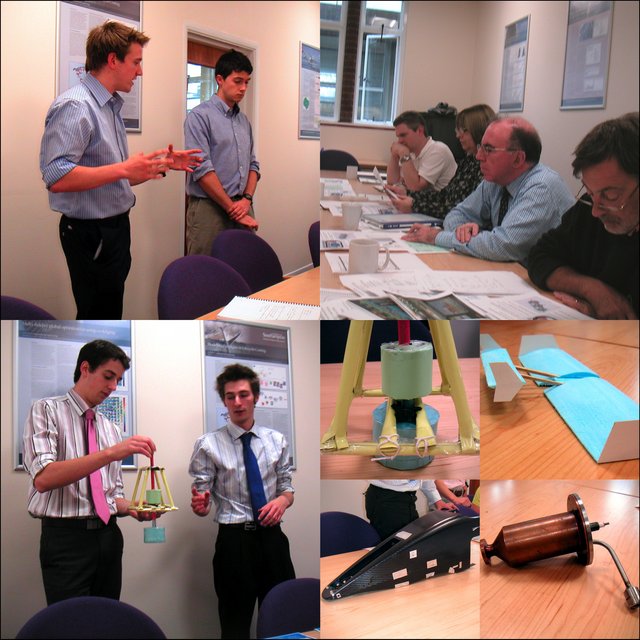
Feedback from students who have taken part in the pitches
This is an anonymous selection of feedback statement from various groups that have presented elevator pitches.
Anonymous Team A:
Is the elevator pitch process a worthwhile exercise? Yes we found it to be extremely usefull, not only as a valuabale experience for the future but as a means of aquiring the additional funds that we required.
Did you learn something (during the process and after having read the feedback below)? Yes, it is very usefull to look at your project from an investors point of view, this helps highlight the key objectives and how they can benifit the university and the generall accademic community.
Did the presentation affect your view of your GDP project? Yes, our sucess in this process has given us confidence in the work that we have already achieved and motivated us to achieve as highly as possible now that we have the required funds.
Do you think the presentation is a useful exercise for your later career? Definitively, it is very important to be able to justify the funds you are asking for in terms of the potentential returns.
Anonymous team B:
Is the elevator pitch process a worthwhile exercise? We believe the elevator pitch was a useful exercise, not only does it ensure that you start the work straight away, it is also a good team building exercise with all members pulling together to research, cost, plan, and prepare the presentation. It was also a good experience for those present for the pitch, as well as developing presentation skills, we were also forced to think on our feet for unexpected questions.
Did you learn something (during the process and after having read the feedback below)? Firstly we learned how to compose an effective pitch. With help from our supervisors and pointers from yourselves, we believe we were able to explain everything we needed to within the three minute slot provided. As explained above, we were also required to give the presentation, and answer questions under tense circumstances, requiring composure and quick thinking, as well as a in depth knowledge of our project. The feedback from the “dragons” was also helpful, displaying the areas we had done well, and where further improvement is needed. This can then be referred back to in future presentations.
Did the presentation affect your view of your GDP project? The presentation allowed us to comprehend the possible potential of our project with the help of extra funding. This helped motivate us to get started, and work hard on the presentation to ensure we have the best possible chance of making this project work, both for our own academic gain, and the university.
Do you think the presentation is a useful exercise for your later career? I believe presentation helped the three who entered the pitch improve their public speaking skills, a very useful skill for our future careers when presenting findings etc. It also helped us learn to communicate effectively and condense information - useful in a variety of areas within business, not just presentations.
Anonymous team C:
We found that the elevator pitch is definitely a worthwhile exercise. Even if we hadn’t been awarded this money, it would still have helped the group to really think about what individual tasks we needed to accomplish by the end of the year.
It was a good experience too, especially with job hunting and careers on the horizon. The point you made about not feeling the pitch has gone perfectly being a normal thing is definitely a valid one in our case. We thought it hadn’t gone as well as it could have so the fact that we managed to secure this money is a very positive experience that we will take away from this exercise.
Anonymous team D:
The team feel that the elevator pitch helped to add a more realistic element to the project and a lot was gained from our experience. We also realised that finances were not infinite, and that the objectives of any project are severely limited by cost, as well as time constraints. We felt that the investors did a good job of setting the right atmosphere and asking the right questions, so that it genuinely seemed that they were investors, and not just lecturers from past modules!
One thing that I personally learnt from the feedback was keeping the answers concise, there was a lot of information which we felt it was important to know, and the strict time limit of the presentation meant that we tried to only include the most relevant facts (but sometimes failed!) We feel that the elevator pitch is a good experience, and is very time efficient, i.e. the skills learnt were significant, but the time required to prepare the speech was minimal in the scheme of the project.
Anonymous team E:
With regards to feedback of the process, as a group we found it extremely beneficial. Although we didn’t get the funding, the experience of planning for such a presentation greatly developed our project planning and understanding of our key objectives. The feedback we received has made us realise that in such a process, one needs to look at the project from the investor’s point of view, i.e. what are they going to get out of it (in terms of benefit to the University). Finally, I’d say that the elevator process is a great experience that is extremely useful for your future career, in terms of being confident in giving presentations and being able to justify everything you say.
Anonymous team F:
We found the whole elevator pitch process worthwhile as it gave us the opportunity to gain more funding since other sponsorship is hard to attain. It was also good practice of presentation skills. The elevator pitch was helpful to define our project and the areas that need to be focused on. We feel that the whole process could have been improved if piles of cash were visible on the table, like in dragons den.
Anonymous team G:
We have found that the elevator pitch is a very interesting and worthwhile exercise. It gave us the opportunity to achieve sufficient funding to develop our project further. It was also useful for us to practice our presentation skills and it put us in a real life situation which will be really useful in the future, i.e. Business presentations. The pitch has helped us work as a team and all information pulled out was very useful and relevant, not only for the pitch but also for the project itself. There were some tough experiences during the pitch because of the pressure and tension. But in the end, getting the funding was very satisfying and motivational. The whole process was very fun because it made you feel as part of a business company or working for industry. Thanks to the pitch we’ve been able to acquire or sharpen some of our skills such as: speech, presentation, communication with the team. The feedback which was provided will help us to correct our weaknesses for our future presentations.
External references