
1 Universities business challenge
1.1 What is it?
A simulation of business processes with teams from universities across the UK competing against each other. More details: http://www.uk.ubcworldwide.com/content/about_ubc.asp
1.2 Why should I take part?
Different reasons have been quoted:
educational
fun experience
looks good on cv (team work, management, business skills)
desire to win prize money (GBP 1000)
1.3 Where can I find out more?
1.4 How can I take part?
Find a team with up to 5 students. The team may include SES students (postgraduate and undergraduate) from all years of study.
The team caption will have to email Hans Fangohr (fangohr@soton.ac.uk).
The email subject should read: Application for UBC
In the body of the email, include the list of team members.
The first two teams registering their interest by email will take part in the business simulation on behalf of SES.
1.5 Queries
If you have any questions with respect to the UBC or the selection process, do not hesitate to contact Hans Fangohr (fangohr@soton.ac.uk).
1.6 Feedback from teams taking part in the UBC 2007/2008
Team 1:
We think it a good experience for students to participate in this business game. It will give them a rough idea what decisions businesses have to make in the real world. Especially engineers should have a general idea about how businesses operate and what aspects are important to consider for production for example, like ordering materials on time to ensure a smooth production.
In the first week, we spent some hours reading through the manual to understand, how this game worked. In the remaining weeks we roughly spent 45 min per week to make the decisions.
In addition we created a simple excel spreadsheet to help record the decisions that we made. These allowed us to see how costs and revenues, hence profit, would change accordingly.
In order to avoid mistakes, we recommend studying the decision form very carefully as a simple mistake reduces your chances to do well.
All the decisions we made, we discussed altogether as a team and often had to make compromises. We did not require much help from Dr Fanghohr, but we did ask occasionally for help from the organiser of the game. In aerospace engineering we do not have a management module in the first two years, so it was unrelated to our course, but still a good experience
Team 2:
The UBC challenge was both interesting and rewarding in the sense that we all gained valuable experience in dealing with business and financial aspects of managing a company. For all of us this was the first time we had dealt with this area, which meant we had a lot of initial learning for us to understand the principles and terms involved.
As well as the challenge being demanding in many ways, it was also an enjoyable experience because we were the people solely in charge of making the decisions for the company, a position which none of us has found ourselves in previously.
Our team took on the UBC challenge without fully knowing what it would involve, but in hindsight, we feel we made an invaluable choice in participating in this business game. This is why we would defiantly recommend other students taking part in this challenge. One of the reasons for this is that many graduate employers feel that many graduates lack in business skills and awareness through lack of this area in many degree schemes. Hence, being able to say that you have undertaken a 6 week+ business simulation is in our opinion extremely useful.
Initially the workload of the UBC challenge looked quite large, but this was because of the initial reading about how the game is run and information about our designated simulated company, which were essential reading for all of us. In the first week, we all independently spent approximately 10 hours reading the above information. From then on, we met once a week to decide our various company decisions. The time of these meetings gradually decreased over the competition, ranging from 3hours initially, to 1hour towards the end when we became more efficient at our decision-making and calculations.
The greatest learning curve for us was the business terms and principles used in running a company. We had no prior knowledge in this area, so everything was learnt from scratch. This was difficult at first, especially understanding the information we were given about how the company did on the previous trading period and how we had to follow on from there. UBC broadened our outlooks on the business world and made us realise to some extent the many interrelating aspects that have to be taken into consideration when making decisions for a company. Teamwork skills were of course gained from such an activity, along with an insight into the role of a team of managing directors; however, these were outweighed by the skills gained in business and financial areas.
In respects to whether this game relates to the degree programme, we believe it far outweighs the worth of, in two of our team member’s cases, the management module in part2 mechanical engineering. This is because far more is learnt from a practical approach to this subject area than lecturers and a general essay. We believe the two are not related in terms of whether they help each other because we did not feel that they did in any significant way. We do believe that since we felt that only a vague understanding of accounting and finance was gained through lectures, that doing the UBC is a good way of greatly enhancing your knowledge in this area.
There was no support from the SES representative, but this was deliberately chosen to be the case from our representative. The choice of a team having a representative in the university is optional anyway, so we did not expect help from this source. We would also like to point out that there is a dedicated helpline for the UBC challenge, where help can be obtained if necessary; however, we did not feel the need to use this.
We had a mixed sex team, which we felt was a good exercise in gaining experience in working in such a team as this. However, since on average only a couple of hours were spent a week on the challenge working as a team, it is debatable whether this led to a significant increase in team working skills. If more time and more meetings per week were arranged, or a team got through to the semi finals, we feel this would change, especially for the semi finals, as this is an intense day with demanding time limits.
In conclusion, our team strongly believes that this is an outstanding chance for engineering students to gain invaluable experience in dealing with business and financial aspects of managing a company. We would fully recommend this to anyone, no matter their previous experience in this area.
Team 3:
We all really enjoyed the University business challenge, and would definitely recommend to other people considering doing it. However it is important to know that it did take up a lot of our time, and this was difficult to manage alongside coursework and deadlines. To start with we were spending up to 5 hours on it per week; the first couple of weeks were used to get the team working together well, and making sure we understood (roughly) what we were doing. The first couple of weeks of decision making took quite a while, with some very strong debating going on, once we had grasped that most of business management is being sensible, watching what’s going on, and not being too silly, the decision making process for each weeks decisions rapidly shortened, while our enthusiasm continued to grow. It took a few trading period to get our heads around some of the business concepts, but once we understood the decisions in full, it became much simpler making the decisions as we could anticipate what our actions would do a better. Closer to the end we produced a spreadsheet that did all the calculations for us and predicted the outcomes of changing variables which also shortened the decision making process.
We were lucky that we worked well as a team, as it does require a lot of team work. It could not have been done on your own. It mostly consisted of discussion, and we all learnt from each other’s ideas and strategies. It was helpful to be able to bounce ideas off one another as it was able to cut down the time taken to reach decisions. It would have taken much longer had we not communicated well as a group. Also it was easier to discount many eventualities in the decisions as everyone would have a different view of the situation, enabling us to reach decisions that were well balanced.
We have not done any management at university as of yet; however this gave us an insight into business and opened up that career path. As we do not do any management modules until next year, we had no prior experience of this sort of thing, so it has been a steep learning curve, but well worth it. I am sure that when we do our management module this will help in putting some insight behind the theory of the lectures.
The IBM UBC was an enjoyable experience from the outset and we would definitely recommend the UBC to anyone, whether they have an interest in management or not, the reason being that having spoken with several employers, they value teamwork above most things, and see a sense of business awareness as a vital asset. Both of these things are instilled by the UBC, and above everything else, it GREAT FUN!!!!
The semi finals were a completely different experience. We attended the BAE Systems sponsored semi finals at Farnborough. In summary the whole day long event was challenging, engaging, interesting and last but not least a lot of fun. It was much more challenging to complete the decision forms under time pressure while we not only had to make the right decisions but also had to make sure that everything was correct. It was very interesting how the similar system of decisions and results can be applied to a very different company. The competition was really intense and the results show there were only very little differences in the total points at the end. All teams did they best and was great to have so smart and enthusiastic people as opponents. It was very challenging all the way. The day was very well structured and the small tasks between the trading periods were really fun as well as interesting, so we never got bored.
The competition was a great experience overall and we learned a lot during it. The main thing I would like to highlight between many other gains is our improvement in team working. We had a great team and it was amazing to see how much efficient work sharing and brainstorming can increase our performance. We all worked in teams before but never under such a tight time pressure. I think the experience we gain in team working during the semi finals will be extremely useful in the future in our jobs. We also learned a lot about businesses, terminology as well as how decisions made. Business is not part of our course at university but this extra knowledge is what many employee searches for. At the end of the day everybody agreed that it was a fun experience, even though we only came second nobody was disappointed because we all had fun and gain so much. And we managed to claim a prize for a small theatrical performance of our “superman” and the very well made F-35 model.
- Update 28 February 2008:
Team 3 made it to the semi-finals and obtained the second place in the semi finals. (With 232 teams starting, and 8 semi-finals taking place, this ranked them to be among the best 16 out of 232.) Congratulations!
1.7 Pictures from Semifinal 6 February 2008 at BAE Systems (Farnborough)
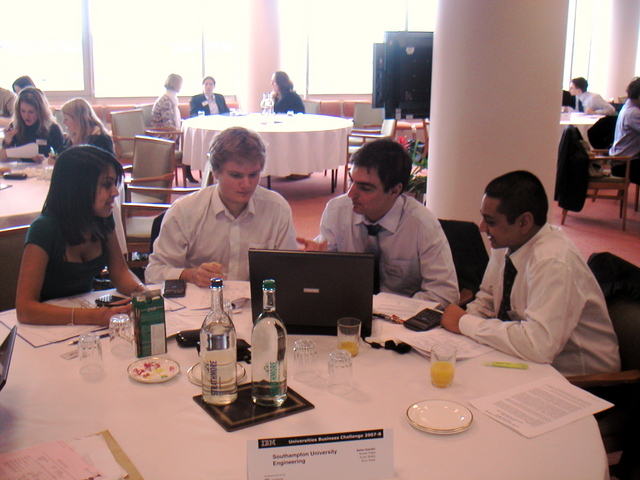
Team 3 working out business decisions under time pressure in one of the 30 minute trading rounds during the day.
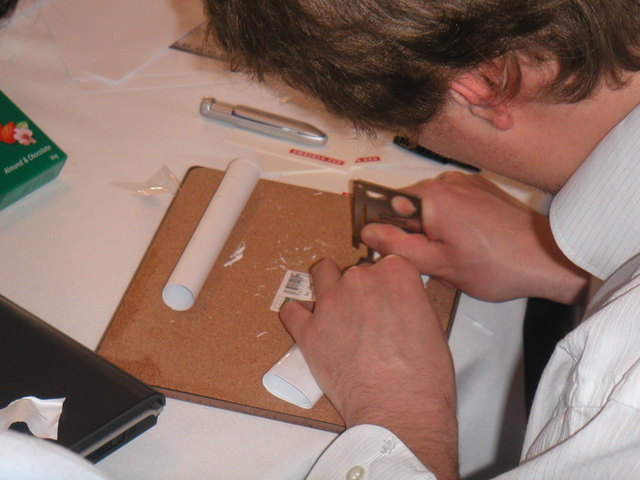
Some proper mechanical engineering taking place in one of the exercises.
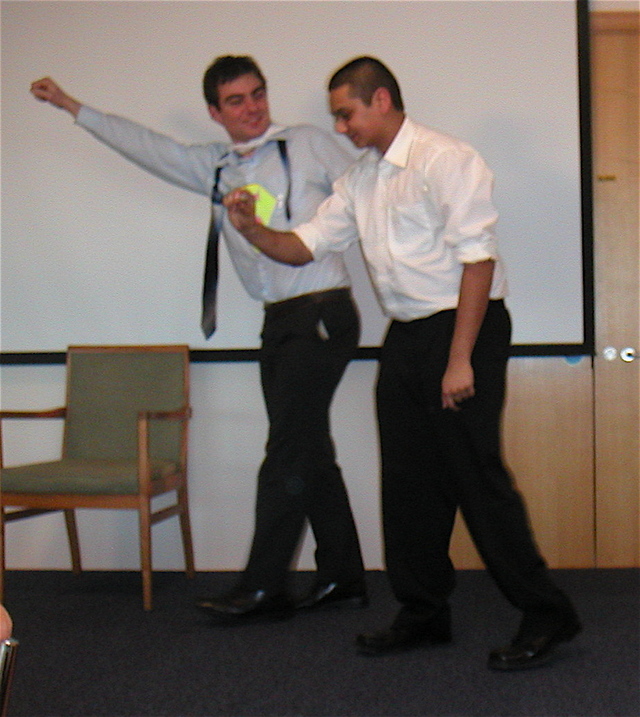
Superman is just overtaking a bullet shot from a gun (part of an acted advert the team had to invent and present). The Southampton team has won the “Innovation and Creativity” group prize for this performance.
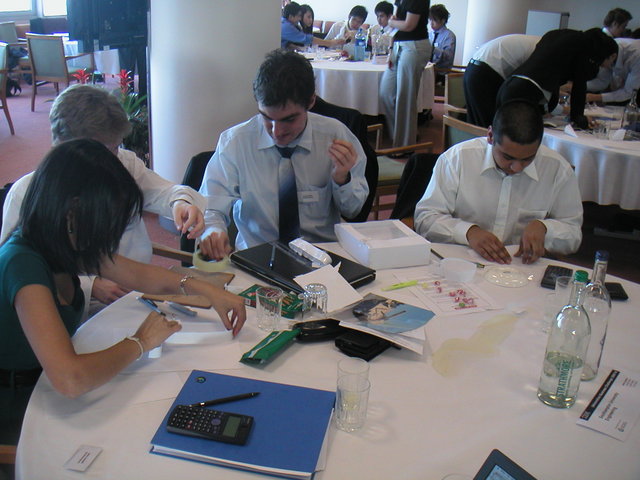
Team 3 working together to build a paper model of a BAE systems product. In the background: competing teams.
1.8 Publicity
Article from the Learning and Teaching Enhancement Unit of the University of Southampton from 19 March 2008