
PhD project on micromagnetic simulation methodology
Are you interested in one or more of
Introducing new computational methods to produce simulation results faster and/or more accurate, both on the algorithm side (fast multipole for example) and on hardware side (maybe exploiting GPUs)?
Adding new simulation capabilities and using those together with world-leading researchers to support experimental work in academia and product design in industry?
Use multi-physics simulations to make simulations quantitatively predictive?
Couple different simulation techniques for different length scales to improve accuracy and predictive power of simulation modelling?
Develop and improve software executing in parallel on large computational clusters (such as Iridis) or Supercomputers (such as HECToR)?
Like Python? Cython? C? C++?
Then get in touch with Hans Fangohr <fangohr@soton.ac.uk>.
Applications and informal enquires are welcome any time. We normally recruit for September, i.e. September 2015 is the next opportunity. It is advisable to apply as soon as possible.
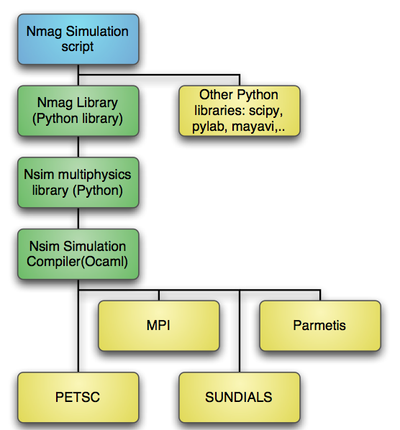
The image shows as a case study the schematic overview of the Nmag structure: The end-user sees a Python
interface (blue) which is the simulation script that makes use of a
Python library called nmag. Below this, there are a few layers of
interpreted code (first two green boxes), before compiled code (third
green box) links to established high performance computing libraries
(yellow) which can execute in parallel.
We have a number of future projects underway, which are based on similar basic ideas: a high level convenient function (such as Python) at the top, combined with high performance code (often Cython, C or C++) as the backend.