
Joule Heating in Nanowires
Hans Fangohr, Dmitri S. Chernyshenko, Matteo Franchin, Thomas Fischbacher, Guido Meier, Joule heating in nanowires, Physical Review B, 85, 054437 (2011)
Preprints available (content identical):
Software tools available (to compute the increase of temperature in nanowire on substrate analytically):
Motivation
The need to use very large current densities to drive domain walls in ferromagnetic nanowires raises the question of the temperature increase in these wires due to the ohmic losses of the current. In particular, it is important to know that the temperature stays below the Curie temperature for the study of magnetic domain wall motion as the ferromagnetism breaks down for greater temperatures and this will affect the interpretation of measured results.
It is also a practical challenge to conduct these experiments without accidentally destroying the sample due to excessive Joule heating from the current.
Summary
Compute the increase in temperature of Py nano wires due to high current density (10^12 A/m^2)
Use multi-physics finite element simulations for detailed simulation
Study effect of different substrate materials (Si, Si3N4, Diamond)
Study effect of (2d) substrate membrane vs solid (3d) substrate (=wafer)
Compare detailed simulation with analytical approximative model for 3d substrates by You et al (APL 89, 222513, 2006)
Provide new equation for estimate of critical time tc up to which model by You et al is valid in 3d substrate (equation 5)
Provide new equation to compute temperature in nanowire as function of time in 2d substrate (equation 7)
Example result (click image to enlarge):
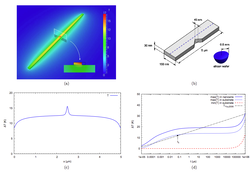
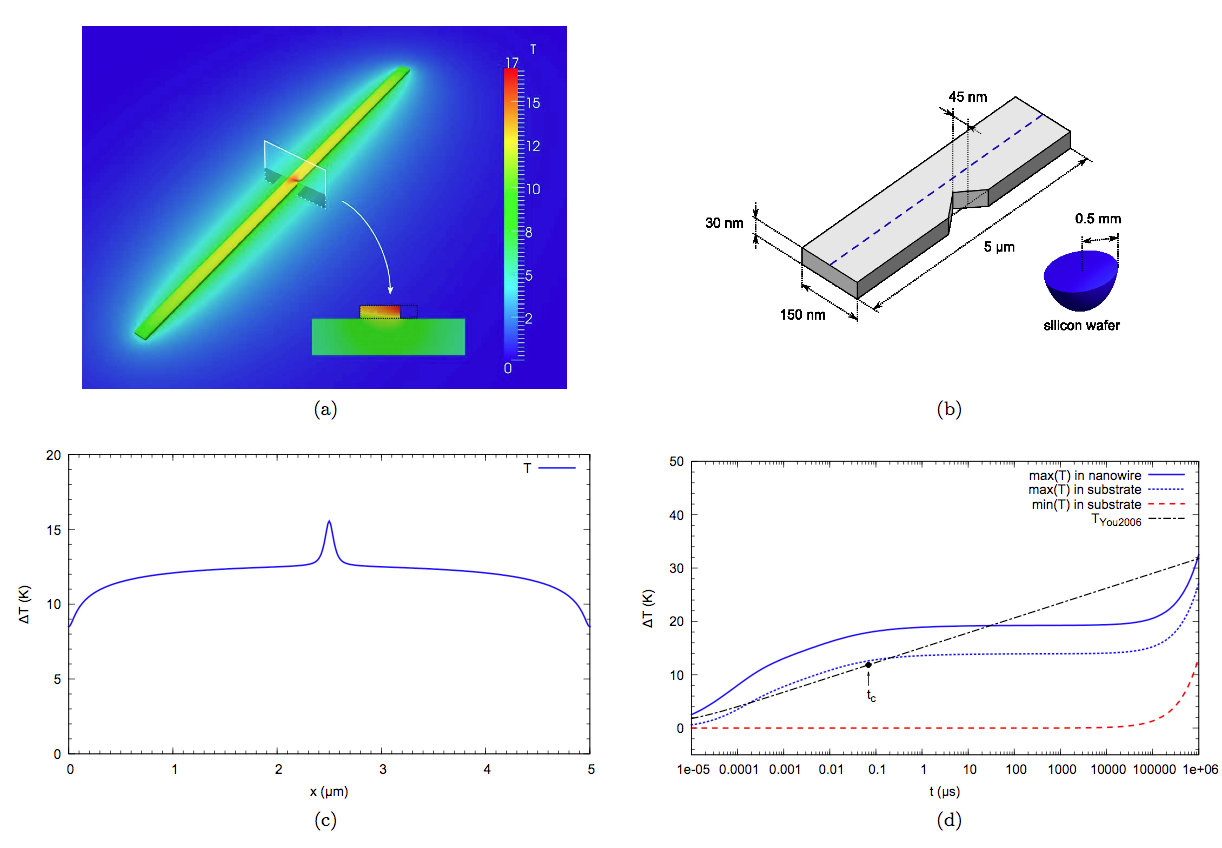
Figure 4 from the publication (pdf) showing (top left) the spatial distribution of the temperature increase, (top right) the geometry of the nanowire with notch and 3d substrate, (bottom left) temperature increase profile through the wire, and (bottom right) temperature increase as a function of time. The Diamond substrate is a very good heat conductor and keeps the sample temperature low.
Tools
Software tools to compute the increase of temperature in nanowire on substrate analytically.
Related presentations
Talk (pdf) presented at MMM 2010 in Atlanta.
Provides
Summary of (finite element thermal) simulation results
Comparison of results with You model
Comparison of critical time estimate with detailed simulations
Bibtex file
The bibtex entry is available here.